Posted on August 25, 2012 in Books

My first Murakami novel! YAY! I have wanted to read him for years, and finally, I have done it.
This book was very strange, but I really liked it. On GoodReads, I gave this a 4, but really this is a 4.5 for me. A lot of my books are probably half points on that site, but I digress.
I do think there are elements of amazing 5 in it, but I found it dark that I am doubtful to pick it up again soon. I usually reserve 5 stars for books I want to really reread.
Let’s preface this by saying I like literary fiction and yes, I do like magical realism. While magical realism is often linked with postmodernism, I find some post modernist books and authors hit or miss with me. For example, I’m not a big fan of Albert Camus.
I do like Gabriel Garcia Marquez, especially One Hundred Years of Soltitude. For a long time, I really loved Louis de Bernières’s Captain Corelli’s Mandolin, but it hasn’t lasted in my reader memory as well as some other books for some reason. I do know that this genre an be polarizing and many people won’t like Murakami’s style. That’s fine; this is why I only ever offer personalized book recommendations. I may really like this book, I know many others who would hate magical realism.
While magical realism does link up with fantasy, I am not one of those people who considers magical realism to be fantasy per se. As Marquez says:
“My most important problem was destroying the line of demarcation that separates what seems real from what seems fantastic.”
In this weird way, I share a similar view to magical realist writers. They put to prose and poetry with how I have experienced life. Feelings and dreaming are not concrete and real life is often too strange as well. As a result, the best magical realist books are those which I can relate to the feeling of how they portray life. I am very much a dreamer, and even lately, I have been experiencing that thin line with what is real and what is fantastic. I do not mean to say that I am living in a dream world or that I am out of touch with reality, but there are definitely moments in both dreams and reality that influence the other. You can not have something without it being defined by its opposite as Neil Gaiman once wrote in his Sandman series.
“fact not be true, and truth may not be factual” (p 525)
It has been a long while since I read anything this literary. I won’t really try to explain this work, but I will say it was at times funny, erotic, introspective, strange, dark, meta, sensual, and violent. I am not sure how much war and violence feature in other Murakami works, but like Kurt Vonnegut and even Joseph Heller, The Wind Up Bird Chronicle has a theme focusing on collective trauma from war and violence. The book does deal heavily in that, but also in the violence of the mind. While some of the acts are not physical and Murakami deals heavily with the subconscious and the other, it still makes an impression.
I often look for characters to attach onto in books. At first, I didn’t really attach onto anyone in this drama. This is difficult in magical realism books sometimes. Characters are transient, hard to reach and mysterious in these kind of works. Indeed, most of Murakami’s characters in this novel appear and then disappear leaving the reader wondering where they are. I got a sense of the protagonist and rooted for him, but I wouldn’t say I cared for him deeply like I would Elizabeth Bennet or Harry Potter. Even so, I find with really great magical realist works, the settings, the situations and moments stay. It’s as if one attaches onto aspects of the story and concepts rather than the characters.
This is not really a book about characters or rather, it’s more than that. I did grow to like the protagonist, he is very much an everyman. I think that makes Murakami really stand out because his settings and writing can set up the most ordinary things and then twist it easily.
“I mean, this is not a movie or a novel. We can’t really do that sort of thing.” (p. 429)
While reading this book, a voice in my head kept saying “This is good”. I can’t necessarily go into many details about why I found it so good; the book even made me uncomfortable at times. It really is almost epic. There are several stories. I am impressed with the amount of things Murakami crammed into this novel. Some people will consider it bloated, but I did not mind. He was able to deftly weave many threads. When I finished reading the book, I felt a bit tired because I felt I had absorbed so much and yet in not that very much time or pages.
I have many questions regarding the ending, but that’s ok. In this instance, I feel like I am suppose to really think about what I read and some books are like life, there is no closure. In any case, I think it did end rather well all things considered. It certainly doesn’t annoy me that I didn’t know what happened to character XYZ.
Finally, I must applaud the translator Jay Rubin. Translation is not easy especially for such prose and style. I once did work where I had to translateand summarize things from one language to another and it was not easy. I appreciate the work of translators especially those of prose and poetry. If you are interested in translation, Japanese and/or Murakami, there is an interesting email roundtable from Murakami’s English translators.
My first Murakami was a success. I think I will try to go from chronological order for his books now. I picked up Wind-Up Bird because it called to me at the library, and I took it out at least two times before. I couldn’t manage to find the time to start it until now. I’m really glad I finally did.
Read August 19-24th 2012.
Posted on August 17, 2012 in Books
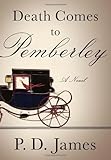
This was my first P. D. James novel, but far from my first Austen adaptation. I do not read a lot of modern mysteries, but I got this book for the Kindle when it was published last year. I even read the first couple of paragraphs back in December, but I have largely read from real books and my large TBR queue since then. The Austen in August challenge made me remember this book so I’m finally reading it.
I have read a number of adaptations of Pride and Prejudice, both published and in fanfiction form. They are not usually amazing to rival Austen’s works, but they can be amusing, fun and a light read. This kind of fiction is essentially indulgent. Indulgent for the author to express their love for the work and indulgent for the audience who want more from their beloved characters.
It is not easy to make a story believable, canon or to engage a reader with their beloved characters. I am generally forgiving about this because no one can be Austen, but you can still write a decent reinterpretation. This work didn’t quite work out for me in that aspect.
As this is my first novel of James, I am not sure what her usual style is. I found the paragraphs and the sentences to be sometimes too long. It was also very expository at times. There was a little too much plot and not enough focus on the characters, and for many of us, we just want to read more about Austen’s characters and their relationships.
There wasn’t enough of Elizabeth and while Darcy was there, I didn’t really feel we got to know him that well until the end. Also, James changed Colonel Fitzwilliam to being less friendly and more tetchier. She gave reasons for this, but the Fitzwilliam in her book does not resemble the one in the original novel at all. I felt this change was just a plot device.
The mystery wasn’t hard to solve, but a lot of the book was focussd on the nineteenth century law trial which was even more exposition. There is definitely good historical details, but it doesn’t make the novel for me.
The ending is melodramatic. It’s a bit over the top and I thought she overplayed a little too much in Jane’s sandbox there. It was just too sensational and also, mostly for plot and not really much for the characters. Darcy and Elizabeth were introspective at points, but I kinda felt it served for more exposition and as a way for James to posit her views about the characters. Sometimes I felt the book was taking itself a bit too seriously.
All in all, an average read and reinterpretation of Austen. While I never had an inflation to read PD James before, I will also continue this feeling after this book. It wasn’t for me.
Read August 14-15th 2012.
Posted on August 14, 2012 in Books
Another reread from the collected minor works of Austen. I won’t do a proper post on Sanditon and The Watsons since they are unfinished, but I rather liked their beginning especially Sanditon’s when I read them three years ago.
These are just two of the juvenilia that I have read from Austen which features unpublished works she wrote as a youth primarily for her family.
Austen wrote this story when she was fourteen. Like most of her works, this is epistolary, and yet again, the right length. I think one early criticism of eighteenth century epistolary novels are that they are too long. I always like the length of Austen’s works; she’s actually concise for her time and I often wish her stories were longer.
This story is almost a fairy tale or a fable. The whole point of it is to mock sensibility and that trend of her time. There is a flair for the melodramatic in this work as the main characters are silly idiots. There is a lot of fainting.
Jane Austen’s predilection for sense in romance is one of the things I like most about her novels. I like that her heroes and heroines fall in love, but the females don’t go around acting hysterical or dramatic about it.
The History of England
This was rather amusing if you love history like I do. If you know British history, more the better. Very tongue in cheek and witty retelling of some kings and queens of England and Scotland from Henry III to George II’s beheading.
It’s a satire on standard history books. It mocks historians and their so-called objectivity. I rather liked her literary references and tone. It’s the kind of work young historians would appreciate and it does make it more interesting to learn.
Austen wrote this when she was fifteen. Goodness, I wish I had a slither of how much talent she had as a youth. I did find both works amusing in their own way and different than her novels of course except I still clearly saw Austen through it. I like her tongue in cheek humor and style of writing, her ability to not take things too serious, and her social commentary.
I recommend the juvenilia to see more shades of Austen
Posted on August 13, 2012 in Books
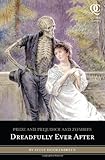
This is the sequel to Pride and Prejudice & Zombies, but the books have different authors.
I realized that while I said in the recent Booking Through Thursday that I avoid horror, this is actually horror. I don’t really think of as such because it’s more humor and weird Regency fused with fantasy. Unlike the other Regency fantasy book I read this month, this one is really different than Austen’s original works. Neither this nor the original are very Austen like, but this one is even farther away from conventional Austen.
I did not have a strong liking to the first book, but I decided to read the second for Austen in August. I was curious how they would continue it. Something I didn’t like about the first book is that I liked the adaptations of most of the characters except Elizabeth is very bloodthirsty and almost cold. She remains slightly more so in this book. These books aren’t big on character development don’t expect it. I do like the series for the idea of the Bennet girls being warriors
The novel was at times amusing, creepy, ridiculous, a bit offensive, and boring. I think the most interesting aspects of it were how the author adapted Kitty and Mary. I thought it was rather nice how Hockensmith really gave them page time development. Secondly, while I didn’t really like this book all that much, I think this author tried harder to than the first author of the zombie series. That doesn’t mean much though, but it was a quick read.
I would only recommend this book if you really liked the first zombie book, otherwise, this is a meh sort of reinterpretation of Austen’s works.
Read on my Kindle August 8-12th, 2012
Posted on August 10, 2012 in Books
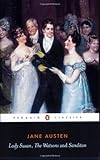
In 2009, I read Sanditon, The Watsons, Lady Susan, and the juvenilia from the Everyman’s Classics compilation so this is technically a reread. I enjoyed the book, but I don’t think I remember much of it so I may as well reread and review this one for Austen in August and the Classics Club.
This features Austen’s attempt at writing a villain and an antihero for the protagonist. This is a short epistolary novella so it’s not first person, but you get to see several characters through the letters. Epistolary works are best in short forms such as this because the format is limiting. Many early English novels are in letter form, but it can drag. This novella had the right length.
Lady Susan is not a good woman. She is deceitful, spiteful, manipulative, vain, not a good mother and yet amusing to read about. Personally, I don’t alway need to like characters in books, movies and film or even feel sympathetic to them, but they must be interesting. I found Lady Susan interesting or at least good to dislike. Like many selfish people, she has this weird logic about the way of world. With her letters, you can really tell she cannot help but think like this. She is just that amoral.
This was a nice, easy read that also had a lot of classic Austen touches, but it really showed another side to Austen. Weirdly enough, it reminded me of all the Georgette Heyer Regency novels I’ve been reading. Heyer has more characters who are scandalous and coquettish. I would recommend Heyer for those Austen readers who like the tone of Lady Susan.
Read on the Kindle August 7-8th 2012.
Posted on August 8, 2012 in Books
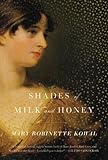
I saw the cover of this book on Pinterest. I do like a good looking book cover so I looked it up and found the synopsis intriguing. Kowal admits to this being heavily inspired by Jane Austen. The book is set in alternate world Regency where magic or glamour is available. Women are valued for their skills in this feminine art.
Jane Ellsworth is the protagonist. She and her sister Melody have a similar relationship to Elinor and Marianne Dashwood except Melody is far more insecure, selfish and spiteful than Marianne. Honestly, she is a little snit for almost all the novel. It was disconcerting to read. Most of the characters aren ot particularly well developed; I wish there was more time on Jane’s father or love interest. I did like Jane as a character though. Kowal paid many homages to Austen throughout the book. You can find hints of all her major novels in Kowal’s book.
If you remove the small glamour magic element, this is like any other Regency set romance. The addition of the fantasy element gives this book something extra which some conventional Austenites won’t like; however, if you enjoy Austen and fantasy, then go ahead. This book is a light read and relatively short in length. It is also marketed as a teen book too.
While I wouldn’t say this book as great or anything, it’s so light and quick that I passed my couple hours quickly. There is a recently published sequel to this called Glamour in Glass, and I have requested it from the library just to see how Kowal does there.
Read August 6th 2012.
Posted on August 7, 2012 in Books
Mansfield Park is the only major novel of Jane Austen I hadn’t read yet. I have seen a couple of adaptations of it so I knew the story.
In a reply comment in the Austen in August post, Roof Beam Reader commented that many people seem to leave Mansfield Park last or that it ends up being their ‘last’ of the Austen books. I think there are couple of reasons for this.
First, Mansfield Park is known as the most serious of Austen’s works. It has the most social commentary, and it has a slightly darker tone about socio-economics in Austen’s times. While Austen has social commentary in all her books, MP has the one which involves a greater inequality between the characters both financially and morally. While this doesn’t necessarily dissuade readers, it is probably the most realistic of Austen’s novels. It is definitely the most somber.
Secondly, Fanny Price seems to have a reputation among the Austen heroines. In the Austen choose your own adventure book Lost in Austen by Emma Campbell, there is one alternative ending which the reader is trapped forever with Fanny in an attic (the horror!). That was amusing, but not surprising to me. I have touched my toe in the waters of Austen fandom online and Fanny doesn’t seem to be many people’s favourite Austen heroine (Austeroine?). While Lizzie has wit, Elinor has sense, Emma has schemes, Anne has maturity, and Catherine has curiosity, Fanny has…? She has relatively less to recommend her. In fact, some find her “insipid” including Austen’s own mother.
I wrote the above even before starting the book. I went in to the book with an open mind and tried not to find Fanny Price annoying. A lot of Fanny’s personality is due in part to her upbringing. She is neglected and made to feel low by all her relations except Edmund. She is shy to begin with but her snobby relations don’t treat her like a person, more like a charity case or property. Only Edmund seems to care about her so I understand how Fanny would be someone without much bravery or self-esteem. Actually without Edmund to protect her, Fanny is abused like a slave girl to her aunts. She takes it all because she is brought up to take it all. Another reason is that her personality type is probably not something in which modern readers can appreciate since her primary traits are frailty, passivity, and morality. Being a forthright female was not something conventional in Austen’s time.
Posted on August 4, 2012 in Books
Another classic children’s book I missed out when I was younger. I knew of this book as a child, but I wasn’t very interested in this genre at that time. I had a proclivity to mythology and fantasy then. I know I would have liked these books since I really liked the books by Laura Ingalls Wilder.
I wish i had read these when i was younger; it is quite easy to attach to these girls. On an interesting note, I read Geraldine Brooks’s March a couple years ago and enjoyed that. Coming into this book, I had her vision of Father March which was definitely more layered than Alcott portrays in this book.
My favourite of the sisters in order is Beth, Jo, Meg and then Amy. I felt the latter two actually developed the most from beginning to end which is always a testament to the writer’s ability for characterization. I do not have siblings so I can’t relate to how the girls were to each other, but it was lovely.
I had some teary eyed reactions to certain scenes in this novel. The older I get, the more easily I cry or tear up when I read books or watch movies. As a child, this rarely happened. This is such a touching novel where all the characters develop but aren’t perfect, and it really emphasizes how there is always something in one’s life to be grateful for and people that care and love for you. It’s a very human novel.
The story made me a tad sleepy, and I mean that in a good way. It is very relaxing to read and well suited to bedtime reading to children. All the chapters end neatly and with optimism.
The whole novel ends without any loose ends. I do feel Laurie and his wife end up together as if thrown together. There wasn’t that much foreshadowing for them. Similarly, that Jo would end up with who she did too. Alcott wrote it in well and did surprise the characters
I know this is the first in a trilogy, but I don’t feel inclined to read further. The ending left everyone happy and content. I admit to liking part one slightly more than part two. Alcott had actually published them as two volumes which is why this book does feel like two books in some ways.
Read on Kindle July 27th to August 1st, 2012.
Posted on July 31, 2012 in Books
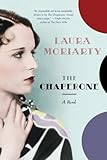
An enjoyable historical piece. I picked out this book because it is set in an era that I don’t read much of, I am fascinated by Louise Brooks, and it got good reviews.
This read went by much quicker than I thought. I think because I became quickly absorbed into the story of Cora. The book isn’t about Louise Brooks; she’s just a sideline character and an anchor in a way. The novel was interesting in a few ways. First, Laura had layered Cora’s life in such a neat and well written way. She kept building onto slowly and there were a couple of good surprises; however, she does them without being gratuitous or shocking.
Louise was annoying through all of this novel. She isn’t an overly developed character in this novel, but she isn’t one dimensional either. The writer makes it that Cora observes Louise and herself in those heady days and weeks they spend together in New York.
I adored the period setting. Moriarty seemed to really capture that time not only in the details of clothing, the current events, but in the mentality of people. At least, as much as you can writing a book 90 years from the time. As a modern reader, one may not really understand Cora’s views about prohibition or clothing, but you can at least understand it being a product of her time. Still, Cora was very forward thinking compared to many of her contemporaries and that is what makes this novel work its pathos and attachment. I found the character real through her sadness, shock, disappointments, happiness, and goals.
As both a character novel and one about the early twentieth century, I liked this novel.
Read July 29th 2012.
Posted on July 28, 2012 in Books
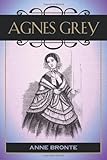
My first Anne Bronte work. I had to resist reading The Tenant of Wildfell Hall for just a bit longer since I had this already on the Kindle and knew it to be Anne’s first novel.
This novel is somewhat autobiographical in nature, it’s not Roman à clef, but when reading this novel, it felt like a lot of the scenes were nonfiction and had actually happened to Anne Bronte. It is a novel about a governess and what it is like to live in that nebulous social position in a household where you are a lady, but also a servant; a caretaker, but not a mother who can discipline. A lot of the scenes felt sadly real and frustrating.
The writing is mature, advanced, and modern. I was aware of Anne’s style being more realistic and forthright than that of Charlotte or Emily. This is why I think she will become my favourite Bronte. There is a sense of modernism in her works. While the tone is still very Victorian, there are moments that could be in any novel after the 1900s. While I really liked Jane Eyre, and I have read Wuthering Heights, neither of those books are particularly realistic in terms of their plot. This one is the opposite. Though, I like Jane Eyre because Jane was so relateable as Agnes is in this book.
A nice passage which builds Agnes’s character, having arrived after a long journey to her second job:
I sat down beside the small, smoldering fire, and amused myself with a hearty fit of crying; after which, I said my prayers, and then, feeling considerably relieved, began to prepare for bed
I love that line, “a hearty fit of crying”; I’ve certainly done that.
Some parts of the novel were difficult to read because it was frustrating for Agnes and for the reader. She really suffered in her jobs, especially her first. She was patronized, neglected, ignored, and had to content with little sociopaths and insufferable spoiled snobs. It was evidently demoralising for Agnes and for Anne Bronte as well. There were a couple of instances of coyness and sense of humor in the writing that once again shows how forward and engaging a writer Anne is.
Religion has more of a presence in this novel than in the other Bronte novels I have read. Anne is allegedly the most religious of the Bronte sisters. I do think the writing shows that she has a strong sense of what is right and wrong. While I do not think the book is moralistic or heavily religious, I was less interested in biblical discussions in the book, but there are only a couple. They act as a good showcase for the time and from a character point of view, you can see how Agnes (and probably Anne in real life) endured her work and life owing much to her faith.
I liked this novel. I think it has a lot of pathos and realism. For a first novel, it is very good, and I look forward to more of her writing.
Read on Kindle from July 23-26th 2012.
Posted on July 23, 2012 in Books
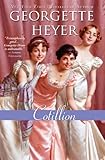
When I first heard about Georgette Heyer years ago, this was the title that I remembered. I could not find at this at my library, but I got it and a few other Heyer books on Kindle just for the event that I would run out of library heyer books.
Similar to other Heyer books, there is a large ensemble cast of characters, but I found them all more defined than usual in this. There were actually three couples in this novel, perhaps one could say four, and there was even more than one love triangle. There is usually very to no little triangles in Heyer books which is a good thing actually.
Also, there was a villain in this story in the form of Jack. While not a classic villain in the sense that all the other characters detest or are afraid of him, he is decidedly very selfish, arrogant, and lends a negative atmosphere whenever he was on the page. It was interesting because Heyer hasn’t written many characters like Jack, and while he never does anything really dastardly, one can clearly see that Jack is a scuzzball.
Kitty is a decent Heyer heroine, but not as good as some of the other ones. She develops through the novel, but she is just a few pence/pennies short of being as interesting as Sophy, as forthright as Frederica, and as introspective as Annis. She had potential and showed it throughout the novel, but something wasn’t there to make her one of the better Heyer heroines.
I often find that I always love one out of the characters in main couple of Heyer’s novels more than the other. It’s not like that in Jane Austen, where I often find I like both the characters as much as the other. In Heyer’s case, I usually find one much more interesting and well developed than the other. There are exceptions to this such as A Civil Contract, but I found Freddy more interesting than Kitty in this novel.
Freddy admits to have no brains and not being as sauve as Jack, but he trumps all the men in the book of course. In the Heyer, where she gives her romantic male leads some deficiencies, but you clearly see how good and true men they are. Freddy seems to be this young man with not much going on and then when he does Kit this favour, you can see his good heart and his quick wit. I was indifferent to Freddy for most of the novel, but the way he acted in the last couple of scenes was lovely. He made the book for me as it sometimes happens with Heyer books.
Read on Kindle July 19-21st 2012. 42nd book of the year.
Posted on July 20, 2012 in Books
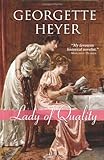
I did not know until writing the end of this review that this was one of Heyer’s last novels; it was definitely her last romance. This novel was not the most exciting of Heyer’s, nor did it have the best characters, but it was one of the most introspective about romance and love. There wasn’t a lot of it, but the main protagonist did think and talk about it more than any other Heyer heroine I’ve read yet.
Annis Wynwood is an independently wealthy nine and twenty year old. Like a lot of ‘older’ Heyer heroines, she is clever, sensible and head strong. She has been living away from her family for about four years and likes it. When she receives an offer from a ‘rake’, she considers it:
It was easy enough to undersand why she should so often hate him; nearly impossible to know what it was in him that made her feel that if he were to go out of it her life would become blank. Trying to solve this mystery, she recalled that he had told her not to ask him why he loved her, because he didn’t know; and she wondered if that was the meaning of love: one might fall in love with beautiful face, but that was a fleeting emotion: something more was needed to inspired one with an enduring love, some mysterious force which forged a strong link between kindred spirits.
When she asks her intended if he is sure he wants to marry her and whether they will be happy, he replies
“Well, I can’t answer you. How can I be sure that we shall be happy when neither of us had any experience of marriage? All I can tell you is that I am perfectly sure I want to marry you, and equally sure you are not a ‘mere passing fancy’ of mine!”
I rather enjoyed these exchanges. I’ve experienced the first one and some people I know have. Not necessarily with a rakish person, but falling in love isn’t determined by one factor.
On a downside, there was not enough page time for the romantic male lead. I could have had more of them interacting like they did above. I was a tad indifferent to him until the final pages. Also, not much actually happened in this novel which isn’t what I expect from a Heyer novel. Sometimes, the couple are driven by other calamities and friends, but in this one, it was mostly centered on the main couple, but even then, mostly on Annis. The other characters seemed more superfluous than usual.
This Heyer novel was also notable also for its number of kisses described. Usually there is one or two embraces, but in this novel there were at least five. I like how you can clearly see the progression of Heyer’s writing from when she started in 1921 to this, her last romance book in 1972.
Read July 16-18th 2012.