This week, I finished reading the Promethea series and The Adventures of Sherlock Holmes (review up tomorrow). I have been reading The Name of the Rose rather sparsely and will devote some time to it today as well as The Memoirs of Sherlock Holmes. As for the rest of the week, I expect I will finish TNotR, more Holmes, and probably start Alain de Botton’s Essays in Love.

Yesterday, I went through several guidebooks for this trip I am going to be taking. While I did not read the books cover to cover (and thus not included in my official reading list), it took up most of my day reading bits here and there. It was quite time consuming, and I still have other books to go through next week. I find that I read quite a bit, but sometimes it goes unrecorded because I really do not consider books read if I have not read, say 95-98% of it at least. When I read for school, I often did not consider the textbook read unless I read most of it. I do not think I have considered a school book read since high school since most academia is journal articles. Though I did quite a bit of it. 

The Guardian has an article on reader’s block: readers and their unfinished books which quotes Francis Bacon:

“Some books are to be tasted, others to be swallowed, and some few to be chewed and digested: that is, some books are to be read only in parts, others to be read, but not curiously, and some few to be read wholly, and with diligence and attention.”

The article discusses how many people in Britain (and probably in general) try to read more challenging books (classics) and end up not finishing them. The novels least likely to be finished by Britons can be found here (amusingly, I have read and finished five of them and own six of them). Some parts of this article are rather sad. I mean how can one not know how to turn pages? In the end, it is as I and the article have said, just read something you like. If the book makes you enjoy reading, then all the better. I must admit that even I get reader’s block with my TBR piles because I often do not have time to read if it isn’t summer or a holiday nor do I am I always in the mood for classics. The reader’s block pandemic seems to be wholly human and our propensity for short attention spans at times.

On a related note, The Times has an article called “Stoooopid …. why the Google generation isn’t as smart as it thinks” about how the current young generation is being stupified by the digitalization resulting in many people not having a long enough attention span to a book. The article has a rather dismal outlook for the young people right now, and I am of this bracket. Objectively, a lot of it has truth. All this information does not make us smarter necessarily, and Facebook and Myspace are creating odd little social relationships and interactions. On the other hand, I am rather optimistic of my own personal future because I do read lots of long books by dead guys and enjoy it. I do not live off “peer attention”, and I am someone who likes older things from books to movies to letter writing. I also am on the internet quite a bit, and while I do skim or glaze over certain sections of books, it does not mean I would not be able to read War and Peace. I think for long books, a little bit of skimming is alright and wholly human, not part of the internet age. We have short attention spans even without the internet, and we foster that by being addicted to things in the digital age.

That concludes this week’s Sunday Salon. Have a good last week of July.

Literary Link:

GoodReads’s Best Utopia, Dystopia, and other world fiction

This review covers the whole series from books 1-5. I quite enjoyed this graphic novel series by Alan Moore, J. H. Williams III, et al. There are style and art changes throughout the series. The story has themes of folklore, mythology, spirituality, magic, and most of all, imagination. It is very epistemological and a bit psychedelic (in the good way). Sometimes, a lot of the concepts went over my head, and it really is a series that requires reread to appreciate all the messages and the beauty. There were many times I did not know where to look as so many things were on the page. It is meticulous and beautifully done. By Book 5, the series gets incredibly meta; it is very cool. I can not really summarise all the ideas of the series, but it is fascinating. I would love to own it and reread it when inspiration strikes. I’ve grown to really love and appreciate Moore’s work, and this may seem like a shift from The Watchmen and V for Vendetta, but at the same time, it is not. He is still spiritually and emotionally evocative in his works. I would highly recommend it to be people who are open to fantasy, epistemology, philosophy, and visual storytelling.

What are your favourite first sentences from books? Is there a book that you liked specially because of its first sentence? Or a book, perhaps that you didn’t like but still remember simply because of the first line? – BTT

I don’t know if I have liked some books specifically because of their first line. Though, like most readers, I like a good first line. Looking back on some first lines, I like the lines more in memory of the fact I liked the books. I pretty

Here are some that I like :

“Happy families are all alike, and every unhappy family is unhappy in its own way.” – Leo Tolstoy, Anna Karenina

“My father had a face that could stop a clock. I don’t mean that he was ugly or anything; it was a phrase the ChronoGuard used to describe someone who had the power to reduce time to an ultraslow trickle.” – Jasper Fforde, The Eyre Affair

“I write this sitting in the kitchen sink.” – Dodie Smith, I Capture the Castle

“Many years later, as he faced the firing squad, Colonel Aureliano Buendia was to remember that distant afternoon when his father took him to discover ice.” – Gabriel Garcia Marquez, One Hundred Years of Solitude

“It is a truth universally acknowledged, that a single man in possession of a good fortune, must be in want of a wife.” – Jane Austen, Pride and Prejudice

“Last night I dreamt I went to Manderley again.” – Daphne du Maurier, Rebecca.

“All this happened, more or less.” – Slaughterhouse Five, Kurt Vonnegut

To be fair, I only added books I have read. I would add Tale of Two Cities but I have yet to get to it.

Project 127/365 - Odessa

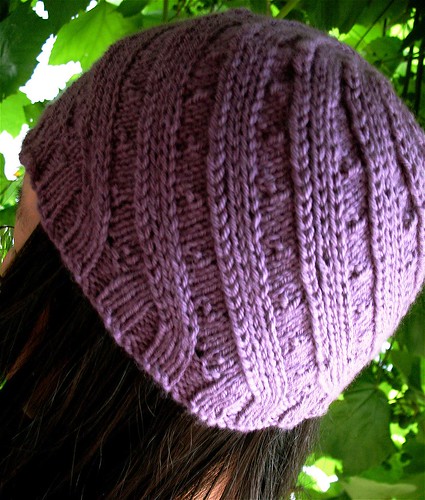
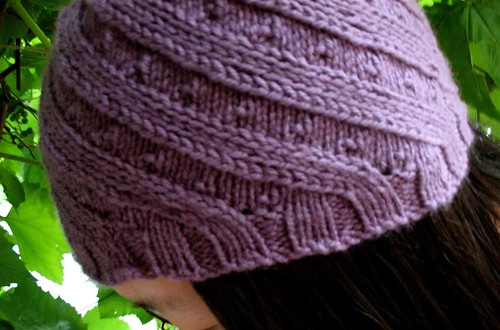
What a lovely hat pattern. I tried to find some beads for this more than once, but I did not have much luck so I just decided to do it beadless and took a tip from another knit blogger by purling where the beads are suppose to be. It was a super quick knit which yields lovely results. I love the yarn; it is yet another oddball that I bought. The colour is great, but the yarn is wonderfully soft to knit with. I suspect it will pill quite easily over time, but that just makes me want to buy this yarn again and make another hat.

Odessa, started July 15th 2008, finished July 17th 2008 Ravelry Project Page
Pattern: Odessa by Grumperina from (now defunct) Magknits, February 2006 Ravelry Pattern Page
Yarn: RYC Cashsoft DK by Rowan (57% extra fine merino, 33% microfibre, 10% cashmere – 50 g/142 yards) – 1 ball
Needles: #3/3.125mm 16″ circs, #6/4.0mm 16″ circs and DPNs

Odessa detail

Modifications: Purled where it indicated BK1
Cost of Project: $6 for yarn
Would I knit it again? Yes! Hopefully with beads next time, but I also think it’s a super easy and quick hat pattern that is very appealing.

Odessaing

This classic is just as intense and loaded as the title implies. It is a lengthy read that is neither easy or light. I found myself absorbed some times, but not always. It was difficult to get into at the beginning since Raskolikov is fairly unsympathetic in many ways. He does abhor the idea that a girl sacrificing herself and put herself up for their family such as his sister Dunya and Sonya. It is part of his overwhelming pride, but he really is less irritating to read about when he defends people. He’s quite the complex and peculiar character, both irritating, but you can sometimes understand people’s love and devotion for him. An apt description:

But what can I tell you? I have known Rodion for a year and a half; he is moody, melancholy, proud, and haughty; recently (and perhaps for much longer than I know) he has been morbidly depressed and over-anxious aboud his health. He is kind and generous. He doesn’t like to display his feelings, and would rather seem heartless than talk about them. Sometimes, however, he is not hypochondriacal at all, but simply inhumanly cold and unfeeling. Really, it is as if he had two separate personalities, each dominating him alternately.

Sometimes he is cold and hateful to those who care for him, but at other times through the novel, he is selfless. I do not think it is inconsistent characterization. He is just a very extreme character who is also a bit mad as well. It is human, and he is a very flawed individual if nothing else.

There is more than one disturbing and overwhelming scenes of violence in this novel. Not just the aggressive violence of blood, coercion and murder, but also the potent effects of poverty, ignorance, and conceit. It was harsh at times, but a testament to Dostoyevsky’s writing abilities. Russian Literature is emotional if nothing else. It was a very psychological read of course, and had so many themes about people, society, criminal guilt, paranoia (is it paranoid when it’s justified fear?), evil, and redemption.

It’s possible that the old woman was a mistake, but she’s not what it’s all about, in any case! The old woman was just an illness . . . I wanted to get my stepping over-done as quickly as possible . . . It wasn’t a person but a principle that I killed! I killed the principle, but I didn’t step over it, I remained on this side of it . . . All I was able to do was to kill it. And the way it’s turning out, it seems I didn’t even manage to do that . . . The principle?

Amidst all these fierce psychological and societal themes, there is actually a small, odd but notable love story. The female characters in the book are the strongest and the most tragic. I liked both Sonya and Dunya as characters. Both contrasted the male characters wonderfully; they were both very feminine (in looks, beauty and elegance), but also very strong, resolute, dignified, and proud in a way that the protagonist and the men the novel could not be. Just with Tolstoy in Anna Karenina, there are acute messages about society’s treatment of women presented here by Dostoyevsky.

Overall, I thought it was an intriguing albeit overwhelming read at times. I am eager to read more from the author, but I am adverse to the idea of rereading this book ever again nor would I recommend it to just anyone (if at all). It is so singular in its intensity, themes, and length (well over 600 pages) that I would have to know the personal’s habits very well to say if they could appreciate it (enjoying may be too much to hope for). Most of the novel goes at a slow pace and things seem to drag quite a bit. It sounds like I was disliked the book, but not really, I think it has its own merits however difficult it is to get through. I did get a sense of accomplishment from reading the book, but it really is not worth it if one is not willing or has any idea what the book entails.

The edition I read is from Penguin Classics translated by David McDuff.


A couple Sunday Salons ago, I was saying how I was cutting back my library borrowed items down, but this week, a lot of requests were filled. It won’t stop because I put a plethora of things on hold this week. They are mostly for personal research, and I don’t consider that I will actually “read” them. Still, there are many books that I take out from the library and know I won’t be able to read them in the limited time. I have too many books at home for the same reason. I am so addicted to books. In any case, it gave me incentive to finish Crime and Punishment yesterday (review up tomorrow) as well as get through more Sherlock Holmes. At this rate, I am thinking that I will read the complete canon. It’s been a week, and I’ve listened to two of the novels and started a short story collection. I only have two more novels and a couple more anthologies left. I am not sick of it yet though I did acquire more Agatha Christie too.

Today, I am going to read books 2-4 of Promethea and start Umberto Eco’s The Name of the Rose. This week, I hope to continue listening Sherlock Holmes and start another book such as Dragonfly in Amber or Hardy’s Far From the Madding Crowd.

The Globe and Mail has an article called “Socially awkward? Hit the books” which illustrates with research support that bookworms, particularly those who read fiction have stronger people skills. I am not surprised by this because I find good novels often have good characterizations and are loaded with themes about society and people in general. I also think that those who read a lot tend to be observers when they aren’t reading. Well, speaking for myself as both an observer. What do you think of the article? Does reading fiction help us navigate the world of social interaction?

Have a good Sunday and week, everyone!

Literary Links:

The Telegraph has 50 Best Ever Summer Holiday Books

Contrariwise: Literary Tattoos – Seems Le Petit Prince is a popular choice for body art.

Looking at Libraries – A nice little way of labelling books on shelves. Pretty labels.

It’ll only took me a couple of days to listen to this next novel in the Holmes canon. I must say, they can be addictive (especially as an alternative to the intense and psychological Crime and Punishment that I am reading). Holmes is developed a bit more in this, but he is still far from being completely humanised. Reading the earlier parts of the novel, I mused that Holmes is gay robot, but then I realised that he was just a an asexual robot with mysognistic tendencies (“Women are never to be trusted entirely,”). Though I think Holmes’s regard for Watson is a winning quality of his. I quite like Watson; he’s very British, stiff upper lip and all, but he is affable. I like the moments of their friendship such as when Holmes plays the violin to help Watson to sleep. This story continues to have rather sensational backstory to the main plot murder that involves a colonial setting, convincts, India, treasure, and a cannibalistic native. As with the previous story, the plot revolves around revenge. Though, one of the antagonists of this story is rather hard to believe when he recounts the tale at the end. One can tell how Conan Doyle reined his technique as he continued to write the Holmes stories. The next one is the first collection of short stories and one of the best of the canon so I’m looking forward to it.

Do you buy books while on vacation/holiday?

Do you have favorite bookstores that you only get to visit while away on a trip?

What/Where are they? – BTT

I actually do not go on travel vacations a lot. My last big holiday and travel was four years ago, and I did buy four books during that three weeks I was in China. If only I did have favourite book stores on my travel spots, but the economics prevents that. I bought books that last trip because I didn’t bring any with me, and I was getting a tad bored in those times when we weren’t going everywhere. That’s when I read Dumas’s The Three Musketeers and where I got Beloved. Just with any place, I buy books when they are usually below a certain price so I like book sales, used book stores, or in this case, where my purchasing power is a bit stronger than in Western book stores.

Hanging Noro Striped Scarf

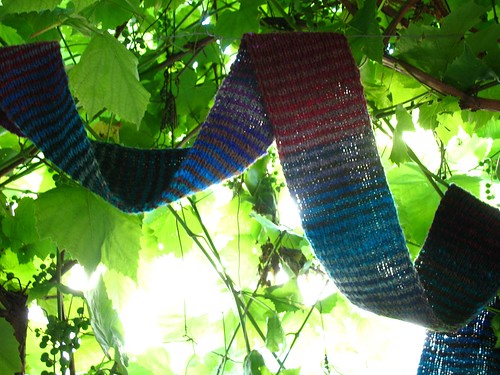
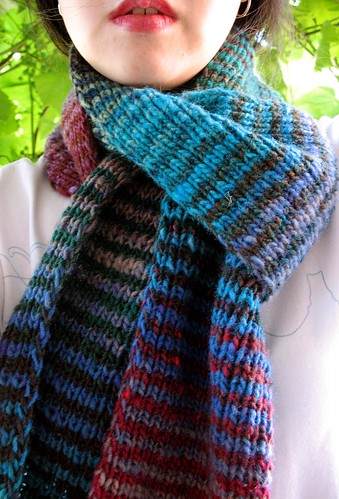
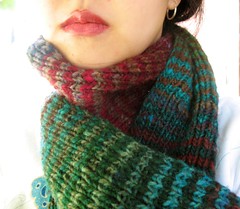
A simple yet enjoyable project with gorgeous result. My second Noro project, but my first time with Kureyon. I love this scarf; I am definitely a fan of Noro. It is yet to be blocked, and I am someone who is not bothered by really course or textured yarn. Though, I may block it eventually when it actually gets cold so it can soften up, but it is already quite long and really wide even when I restarted on a 4.0mm with 35 sts cast on.

Noro Kureyon Scarf Decadence

Noro Striped Scarf, started May 27th 2008, finished July 14th 2008 Ravelry Project Page
Pattern: Noro Striped Scarf as popularised by Jared Flood. Ravelry Pattern Page
Size: 6″ x 76″ (6 feet 4 inches) unblocked

Rollin' Noro Scarf

This was a very enjoyable knit, as I knit slowly while watching films or when on break of other more advanced projects. I really enjoy making easy and enjoyable scarves even after having learned so much. The colour variations of the yarn makes this scarf even more unique and fun than most. This will definitely be my new go-to winter scarf.

Noro Striped Scarf 01

Yarn: Noro Kureyon (100% wool 50g 110yds) – 2 skeins #156, 1 skein #147, and 1 skein #159
Needles: #6/4.0mm
Cost of Project: $28 for yarn (the most expensive project that I have undertaken yet I think)
Would I knit it again? Yes! Next time, I would make it skinnier, and one could probably make one skinny scarf (casting on less than 25 sts) with two skeins of Noro.

Project 123/365 - Noro Striped Scarf

Not too long ago, I was able to acquire the complete Sherlock Holmes canon by Arthur Conan Doyle in audiobook form as read by John Telfer. I highly doubt I’ll listen to all of it, but I do plan on going through chronologically to the fourth and final Holmes novel Valley of Fear. They should make for some decent listening while I knit. I even finished one project while listening to this.

A Study in Scarlet is the first book that features the literary icon Sherlock Holmes and his companion Doctor Watson. There is considerable introduction to both characters before the murder and mystery of the novel is introduced. I think Watson described Holmes best when he says, “This fellow may be very clever, but he is very conceited.” Which is why Watson is the perfect narrator and foil to Holmes. While the latter is probably a genius, he is also very tactless, peculiar, and eccentric in personality. To be honest, I did not care for Holmes all that much in this novel. We see his abilities as a detective, but his personality is still to be fleshed out by the end of this first novel. He is just an arrogant brain for most of this novel. The book itself is split in two with one half being narrated by Watson and the second by a third person omniscient narrator. The latter half is a story set in pioneer America and reads almost like a sensationalistic historical novel at times. It offered an interesting switch to the style of the first half with different settings, narratives and tones. I think this switch is what made me appreciate the novel the most albeit however unrealistic or melodramatic it is. It is too early for me to say that I like these stories. I certainly think Conan Doyle is an interesting mystery writer, but this is my first novel of his, and I have only been exposed (and loved) Agatha Christie before. Actually it made me want to read or listen to more Miss Marple and Hercule Poirot; I quite like the tv and film adaptations those mystery solvers. I digress, but I will proceed to more Holmes stories and sees if I like them even more.

Project 121/365 - Quant

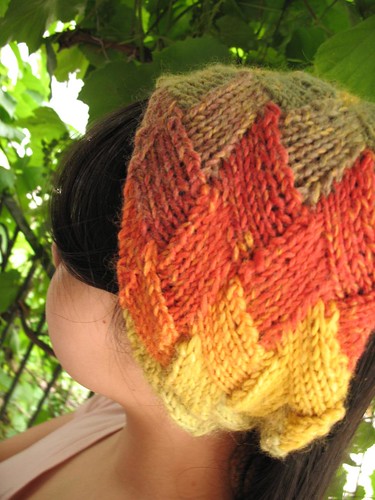
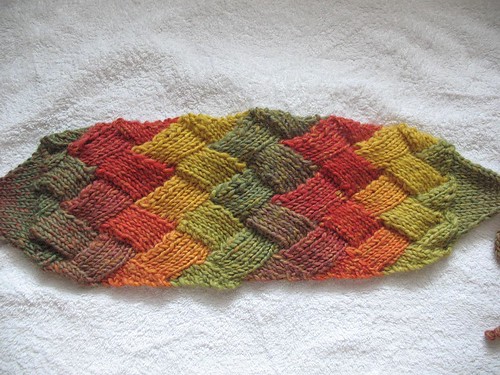
My second entrelac project after Danica. I really like the technique, but I think of the two projects I liked Danica more. I bought this odd ball yarn with the intention of making a Calorimetry with it, but I made one of those earlier in the week for a friend and the Quant entrelac was a-calling. I am unsure if I will wear it since it is flashy and not actually that warm; I have never really loved headbands. It is cute objectively speaking.

Quant, started July 10th 2008, finished July 12th 2008 Ravelry Project Page
Pattern: Quant by Star Athena, Knitty Winter 2007 Ravelry Pattern Page
Yarn: Wisdom Yarns Sonnet #715 (50g 93yds/85m) – 1 skein
Needles: #7/4.5mm HiyaHiya long circs

Quant Entrelac Headband

Modifications: Since I did not have enough yarn and was afraid of running out, I knit only 12″ instead of the 15″ called for and then blocked like mad. I used mightbekatrina’s mods to make it symmetrical at the end:

Ending with Section 1:
Set up: (RS) pick up 5 stitches along triangle edge (6 total), pass last one back to ssk as usual. Turn.
Row 1: (WS) p to last 2 st, p2tog
Row 2: (RS) sl1, k to last st, ssk
Repeat these 2 rows until 1 st remains.
Repeat this procedure for the other two triangle ‘holes’. 1 st will be left on the needle. Turn.
(WS) Pick up 17 more stitches along the edge: 5 in the first triangle, 6 in the other two. 18 sts total.
Row 1: (RS) k1, ssk, k to last 3 sts, k2tog, k1
Row 2: (WS) p all sts
Repeat these 2 rows until 6 sts remain.
(RS) ssk, sl1, k2tog, psso, k1 (or any other 3 st decrease you like). 3 sts .
Work in I-cord to match the other side. BO.

Cost of Project: $4 for yarn.
Would I knit it again? Yes, and maybe try using DK weight yarn.

It seems to be a slow reading week or it felt that way, even though I read and finished Pyongyang and The Life and Times of the Thunderbolt Kid early in the week, I only started and read one chapter of Crime and Punishment. I have knit a little more this week, and as a result, I listened to one short audiobook. I also listened to F. Scott Fitzgerald’s The Curious Case of Benjamin Button which is in an audio anthology of his short stories. I think I am going to look forward to the movie and like it even more. It was interesting. I always have mixed feelings of FSF because while I have two of his novels and liked them, I do not love him, and yet, I still want to read This Side of Paradise and some of his other short stories. Though I think I rather read them than listen to the audiobook.

Today, I am going to read more C&P so I can make a bigger dent in the Russian tome. One chapter is not enough for me to judge, but it seems as somber as expected. Must get back to it; goodness I have loads of books to read off the TBR pile. Here is a quotation to end things. 

Books to the ceiling,
Books to the sky,
My pile of books is a mile high.
How I love them! How I need them!
I’ll have a long beard by the time I read them.
— Arnold Lobel

How very true, except the part about the beard.

<< previous posts || next posts >>