Posted on April 15, 2013 in Books
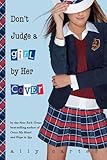
This series is quite highly ranked on GoodReads, and I hadn’t read a young adult book in a while. I also wanted something lighter after Walden.
The premise of teenage spies and the lighter tone of the book was an adjustment. I also wonder that the older I get, the less I can relate to teenagers and thus, find it harder to read these kind of books. There was a lot of talk about boys and kissing. There was also an excessive use of the word “hot”.
Still, the book is rather light and had its fun moments. It moves rather quickly and I read the book in a couple of hours. It is as good or better than Meg Cabot’s YA books. The protagonist is not annoying and the book does place good emphasis on friendship.
I did not realize until about halfway through the book that this is actually the third book in the series and not the first. I must have returned the first awhile back thinking it was the third one. In any case, I was not too confused by the back story. Knowing I have read the third book makes me more likely to read the last and fourth book especially after the cliffhanger.
Read April 13th 2013.
Posted on April 12, 2013 in Books
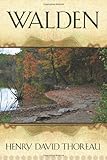
I have mixed feelings about this book.
On the one hand, I think Walden’s ethos and philosophy is largely positive and relatable for me. His views on the appreciation of nature, solitude, and civil life are good and important. I think more people should do the things he recommends.
On the other hand, this book was hard to read. Much harder than I thought it would be. I realized that not many people I know offline and online have read Thoreau’s work. Yes, he is often cited for his subversive views, but how many people today actually do read Walden? I’m sure some people gave up, and I almost did a couple of times.
I liked the content, but I was bored by the style and delivery.
I read this for the Classics Spin and it took me ages. I put it away for nearly a month because it did not engage me. Philosophy in general can be hard to read, but he is sometimes less forthright cut about it than Plato or the Enlightenment philosophers. I think this book would have been improved if there was a plot or more concrete examples. It was as if I was reading a long diary entry in Thoreau’s life. He meanders and his style changed.
Most of this book is not actually about civil disobedience or vegetarianism, it’s largely about nature. Long, overwrought passages on nature. I actually don’t think Thoreau is a bad writer, but there was something incredibly dull about most of this book. Too much waxing poetic. I remember many a number of pages on lakes and ponds and rivers.
In the beginning of the book, I did find Thoreau was erudite, intelligent and true, but at the same time, I found him florid, pretentious and bourgeois. This was the first 10% of the book, the rest he just talk about nature, solitude, and his neighbors. I am not sure if it was the time frame, but that should not be a problem since I have read so many nineteenth century books, but not necessarily philosophy. There was sometimes a feeling of insincerity in his words or slight arrogance about his knowledge of the world. He was only about 30 when he wrote this and I can see that his relatively young age can have contributed. He had not travelled very much and it shows in this book. I also suspect he was sarcastic at times.
Should other people read it? I think parts of the book and certain quotations make provocative reading such as the last section of Civil Disobedience. I think it is also a good book about history and the setting in which he wrote it because Thoreau is clearly intelligent. In terms of reading this for fun, I really do not know many people who should actually enjoy this book.
Or maybe I am blind to how good his prose was, but for me, this was not the most memorable reading experience even though I did agree with Thoreau at times.
Read on Kindle from February 27th to April 12th 2013.
Posted on March 27, 2013 in Books
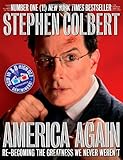
This was a fun book. I didn’t review Colbert’s picture book, and reviewing a humor book is not easy. Still, I smiled my way through this book.
I adore Stephen Colbert. Sadly, I have not watched “The Colbert Report” on a regular basis for a couple of years now. It use to be part of my morning routine from 2006-8. I think Colbert is very funny and clever. I enjoyed the last book, but I think this was even funnier.
The audiobook would probably be hilarious too. I couldn’t find it near me and I wouldn’t have been able to wear the provided 3-D glasses.
Part of what I like about Colbert is that he and his team are clearly very intelligent. The humour that comes with that is smart, but also sometimes very random. It is sometimes a bit sad when you realize how many people actually believes the things he satirizes, but Colbert finds humor in that sadness. That’s what comedy is for to be honest.
I also feel he writes some of the best Canadian jokes by a non-Canadian comic:
Sourry for my superfluuous Canadian u’s in words like “flavour” and “colour”. Up here you gotta layer the extra vowels to keep the consonants warm.
Colbert also has a way with words as in, he uses puns, vocabulary and diction a lot. My kind of comedian. All of this just reminds me that I need to watch TCR more again.
Even though this is pure satire, I think humor counts as nonfiction especially considering how this book touches on so many current affairs issues. I recommend it for all Colbert-Stewart lovers, but also people who like political satire more broadly.
Read March 24-25th 2013.
Posted on March 25, 2013 in Books
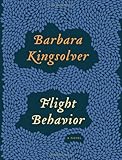
This is my fifth Barbara Kingsolver book. My first of hers was actually her memoirs Animal,Vegetable, Miracle. I absolutely love that book as it is a dream of mine to have a small holding farm like she does. As a result, I like Kingsolver as a person; we share similar interests and philosophies with respect to nature, the environment and more.
I liked her novels Prodigal Summer and Lacuna. Surprisingly, I was less enthused by her most popular work The Poisonwood Bible. I definitely think it has some of the most disturbing and provocative images of her novels, but I found myself a bit cut off from the characters. I was more invested in the leads in her other novels.
Flight Behavior is set in rural Tennessee with a female lead who is intelligent but drained from her life as a housewife with a man she does not love. Kingsolver also writes about rural life in American with respect. She actually reminds me of Thomas Hardy with the way she describes certain nature and farming scenes. Sheep farming is featured heavily in this novel, but the butterfly aspect is also well described.
This book was most like Prodigal Summer, but slightly more somber. As I do not know any one from the rural South, I can not really attest to the veracity and nuances of Dellarobia’s (what a great name too) story. I think Kingsolver also writes her characters with such respect and it is humbling at times to read things in this book.
There is a plot in this novel, but it’s a character study as much as an environmental one. This book does feature the issue of global warming and climate change. While I liked most of the book, my attention seemed to waver a bit towards the end. The ending was unsurprising and sort of just there. It was not deeply profound, but nice.
This novel is not the most exciting read, but for those fans of Kingsolver, I would recommend it and any others who enjoy meditations about climate change in the Americas.
Read March 17-18th 2013.
Posted on March 11, 2013 in Books
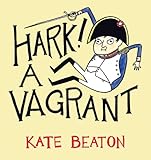
Regular readers of Beaton’s blog Hark! A Vagrant will be familiar with the content in this book, and if you haven’t seen the blog, please check it out. If you like what you see, you can read this lovely book containing comics about literature, comics, history, and often times, Canadian history! In sub categories, there is a fair amount of Feminism and Political History. A few times, her comics are just random out there humor which I also love.
Beaton and I have the same interests in all the above. I get and understand almost all of comics in the book and their allusions. It is funny and apt. Here are the subjects she tackles in her comics in this book: Jane Austen, the Bronte sisters, Crime & Punishment, Nancy Drew, Batman, various works of Shakespeare, The Great Gatsby, Sherlock Holmes and Watson, and much more.
Her commentary is very insightful and intelligent not only in the comics, but in the few times she explains her work. You learn things such as the following:
- H. G. Wells allegedly called Jules Verne an “old fusspot”
- General Montcalm was very romantic
- Brahms fell asleep at a Liszt concert
It is whimsical, fun and educational!
Read February 26th to March 5th 2013.
Posted on March 8, 2013 in Books
Let’s Talk About Love: A Journey to the End of Taste by Carl Wilson
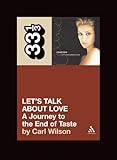
This little book is more than a book about Céline Dion. It is a discourse and meditation on art, aesthetics, taste, and culture generally. It covers much ground in such a small package, and I really would read it again. I recommend it for those of us who question why we like the things we do and why others do the same or not. It’s a book about being open and about being human in culture. It’s about perception, sociology and individuality.
This was another book from Nick Hornby’s column, and I love that we love the same things. Anyway, the premise is that Wilson, a Canadian music critic, wanted to explore the fame of and backlash against Céline Dion. Doing so, he explored how we feel about our art, cultural assumptions and personal taste.
Personally, I am mostly indifferent Céline. I do not really like her English music, and I had one of the worse experiences with restaurant service at her Nickels chain, but I have nothing else against her really. Her existence does not perturb me as a human being so much as war criminals or intolerant people do. I have never really liked how much people have hated her. It seems over the top. As Wilson described, a lot people could not stand her and she became this a symbol of trite and overproduced music. People disliked her without really knowing her and articulating why they disliked her.
As a Canadian like Wilson, I have grown up with Céline in the media, but not being Québécois, I have not been as exposed to her as they are. I do admit my Dad loves the Titanic soundtrack and to my knowledge does play the album at least once a year just for “My Heart Will Go On” which is not fun. I have seen her on Quebec TV singing to Montreal concert goers in French. Her voice and songs are completely different in French. She is much more soulful and that is the
I do think the author understands why Céline is successful. He also how her success is largely attributed to the smart business sense of catering to various cultures: singing their languages, being open, and generally being Canadian abroad. She and Shania Twain seem to share this view of wanting their music to be enjoyed by others, but not putting too much of themselves in it. Still, Céline’s work is full of raw sentimentality and it makes us wonder how that viewed down upon by society . Wilson also conducts interviews with some of her fans which were somewhat interesting, but the core of the novel is the wider discussion of taste.
While writing about Céline’s career, Wilson also discussed musical genres, history, philosophy and more. This part feels a little more dense and serious, but I think he brings up many different perspectives about taste and aesthetics. It was provocative, and I enjoyed this book’s scope.
Read March 2nd-4th 2013.
Posted on March 5, 2013 in Books
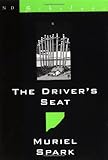
This was a different and strange short novel. Nick Hornby was reading more Muriel Spark in his last compilation noting her ability satisfy with her short novels. Having read The Prime of Miss Brodie, I decided why not.
I started this in the queue to get my passport renewed and it was appropriate because it is about a woman who takes a journey to Italy on a mission. Early on in this story, the reader knows the outcome of Lise the protagonist so there is a certain amount of mystery, suspense and tension on how she gets to the ending.
The story was published in 1970 and the events and even Lise reflect the 1960’s. The book has a dark, violent and cruel ending. It is not precise and does not give you a sense of closure, but it’s memorable with its unique protagonist and Spark’s writing.
I was quite surprised by how dark it was. I was less surprised by the derangement exhibited by the protagonist because I am learning that delusion is a feature of Spark’s characters. Characters in the novel seem to talk at each other than with each other.
This is a story where I didn’t relate to anyone or any concept, but I did like the writing and found the plot provocative and the characters odd. I won’t likely forget Lise for awhile. I’m not surprised this was shortlisted for the Lost Booker Prize as it seems like a Booker story too.
Read March 1st-2nd 2013.
Posted on February 26, 2013 in Books
Bringing Up Bébé: One American Mother Discovers the Wisdom of French Parenting by Pamela Druckerman
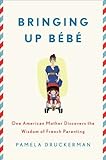
First off, I am not a parent, but I am a francophile and I am interested in culture and psychology as well. I quite enjoyed this book as it outlines a few key and interesting things about about French parenting such as (but not limited to):
- setting boundaries
- babies sleeping through the night in a few weeks
- treating children with respect and trust
- baking weekly with children
- the idea that being a mother is not an absolute and one is encouraged to have a life separate from one’s children; the woman and the mom are fused rather than the mom is the only thing.
- achieving balance and not feelingly guilt
- encouraging children to be children and letting them be themselves.
- marriage after kids
- encouraging children to eat vegetables and not be picky eaters
The book also reminded me to read Jean Jacques Rousseau’s Emile at some point. Nothing ever surprises me about the French anymore though. A few things addressed in this book such as the creche and the importance of “Bonjour” was addressed in another insightful book on France that I own Sixty Million Frenchmen Can’t Be Wrong.
The book did make me laugh though and make me really think about the role of women in their child’s lives because it addresses authority, guilt, and being a person aside from being a mother. I think it is really important to cultivate a life and identity as a woman that is not just about being a mother. The author is correct in that it is not easy and the French state does make it easier.
Overall, I agree with a lot of the things the author observed and while I am not French, certain tenets of their parenting style were familiar in my own Chinese upbringing: the lack of effusive praise, the emphasis on the woman at work, encouraging kids not to be picky eaters, and having the child be their own person. I was not able to take music lessons or sports growing up, but I had books and an active imagination so this relied heavily one me as a child on self-discovery.
It would be excessive to use this book as a guide or bible to parent children. I did not agree with everything namely the lack violence between children bit and the French view of breast feeding. Though, I was mostly raised on formula so it’s not like it ill equips humans for life.
I do think the book is interesting from a psychological perspective and addresses a lot of issues that many Westerners and anglophone parents have with their children: entitlement, childhood obesity, attachment issues, and guilt. The book also emphasizes the relationships they have with their spouses and partners separate than that of the children. It was an engaging read, but not an ostentatious parenting book. I recommend it to francophiles and people interested in parenting from different cultures.
Read February 23rd to 24th 2013.
Posted on February 19, 2013 in Books
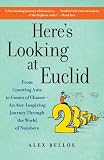
Another math book! Now, I’m averaging about one or two a year. That’s a pretty good number to me considering I am so bad at math. I half force myself to read these books. I do want to know more about math, but I do think a lot of the stuff in these books goes over my head or I forget them very easily. I had this book first time months ago and renewed it several times. I am very bad at math and atypical of many East Asians that way. I failed math in high class and almost failed in nearly every year before that from age 8 to when I stopped in high school. It was a real bane to my existence. I do admire people in the maths and sciences. A lot of my friends are in science, but I do not any math people. Still, I read these books in an attempt to learn more about math and overcome the fear of it. I do not think it improves my knowledge of it, but it is somewhat interesting.
What is interesting is that this math book and the last one I read The Number Mysteries by Marcus du Sautoy were both written by Britons. I am wondering if this is because the British are more open to buying a mainstream math book.
Bellos, unlike du Sautoy, is not really a mathematician. While he has studied maths in university, Bellos is primarily a journalist and writes as one. This means that I found this book easier to understand than the other one. The books are similar though and discuss various topis in math in our daily lives, but this one has some interesting things such as:
- A dyscalculic which is dylexia but for numbers and math
- In Medieval Lincolnshire, England, shepherds called Five a “pimp”, Ten is a “dik” and Fifteeen is “Bumfit”.
- A base of 12 (Dozenal) can be more useful than a base of 10 (Decimal). This makes me think I should count stitches in dozen from here on out.
- Numerology. Numbers as qualities. This is something I have had an interest in as well.
- Vedic mathemetics.
- The basis of zero and how in Indian philosophy, it is the basis of everything.
- 6 is a ‘perfect’ number because it is the sum of all its factors 1,2, and 3.
- The prevelance of Fibonnaci numbers in nature
- Math and the fiber arts
- The Gambler’s Fallacy that people think that things are due to happen because the happened in awhile
I also liked Bellos descriptions of all the people he meets and interviews. The way he describes their faces and hair is rather nice and more observational than some other non-fiction books.
All in all, a nice little read for those interested in math but who don’t know everything about it. I recommend it as a primary for those people who use to like math back in school but have not touched it in awhile. It makes you appreciate many math topics and the history of the subject.
Read February 14-17th 2013.
Posted on February 18, 2013 in Books, TV
A review of Game of Thrones by George R. R. Martin and the first season (2011) of the HBO show.
Posted on February 17, 2013 in Books

Hello everyone!
This week, I posted my list for The Classics Spin (check back tomorrow to see which book I will read for it), reviews of Sandman: Dream Hunters by Neil Gaiman and and P. Craig Russell, The Best American Travel Writing 2012 Ed. by William T. Vollman, and . Also, BTT was on Why I love to read.
I read and finished Game of Thrones by George R. R. Martin as well as the first season of the show. That review will be up tomorrow. I also read Stephen Colbert’s I am a Pole (And So Can you!) which I won’t write a proper review for, but it was amusing. I’m currently reading Here’s Looking at Euclid which I hope to finish later today after I go out this morning. It’s taken me two days to get halfway through the book because it a book about math after all.
Tomorrow, I am returning to full time work to temp again. Now, I am also going to work a Saturday job so that means six days a week at least for a couple of weeks. This will cut into my leisure time, but hopefully I can balance it. I have this weird idea that work begets more work and hopefully better work. I’ve had two jobs before, but not ones amounting to almost 50 hours per week.
Still, I’ll find some time for the books and the knitting here and there. The blog may be neglected for a bit, but I’ll still do my Sunday Salon posts. This will be the only day I have off.
Have a good week, everyone!
Posted on February 15, 2013 in Books
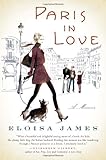
I found this memoirs about living in Paris through GoodReads. I do love the site, and it gives me numerous book recommendations every time I am there.
I have read several books on France and lived in Rhone-Alps one glorious spring and summer in 2010. If i had unlimited financially resources, France would definitely would be one of the countries I’d install myself. On the books about France, a number have been memoirs of living in Paris. This is at least my fifth nonfiction book about Paris.
The book is about a family of two sabbatical professors and their children. The author writes the book mostly in paragraph snippets and vignettes. I was not too keen on this format as it feels there is a lack of narrative. Though there is something quaint about it as it it s written snapshots in a the family photo album. The more I read it though, the more I got into this style as James like many expats in France describe the interesting little moments. I was soon sighing about my own memories of France and Paris. There was continuity in the stories about her children, her husband’s friend Florent, and the author’s food and fashion life.
There are a number of travel tips within the memoirs as it often happens and a couple of good cooking and fashion tips. I really grew to like this memoirs more than I thought. I recommend it to other readers with a fascination for memoirs and Paris. I still think the best Paris memoirs is Paris to the Moon by Adam Gopnik which I was blessed to take with me to Paris the first time I went. Both recommended.
Read February 8-9th 2013.